n today’s digital-first world, businesses need more than just a website to attract customers. They need to appear in front of the right people at the right time. This is where Search Engine Marketing (SEM) becomes important. SEM helps businesses promote their products and services on search engines such as Google and reach users who are actively searching for solutions.
Whether you are a small business owner, startup, freelancer, or marketing professional, understanding SEM can help you generate targeted traffic, leads, sales, and brand awareness.
What Is Search Engine Marketing?
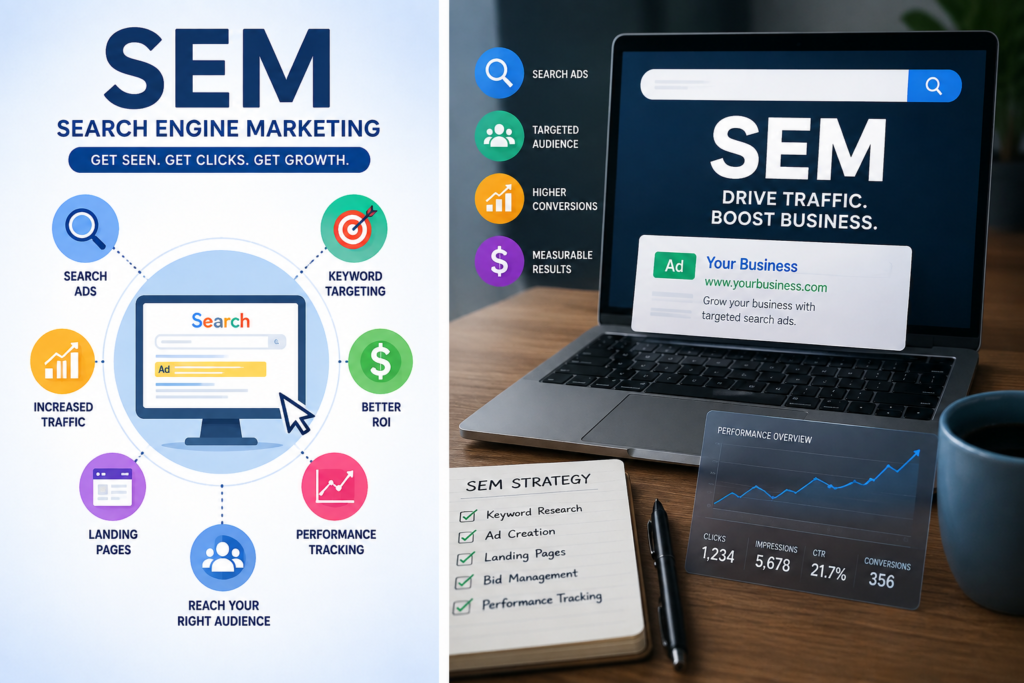
Search Engine Marketing (SEM) is a digital marketing strategy used to increase a website’s visibility on search engine results pages (SERPs), primarily through paid search advertising.
For example, imagine someone searches Google for “best digital marketing agency in Bangalore.” Businesses can create paid search ads that may appear prominently for that search. If the user clicks the advertisement, the business can direct them to a landing page designed to generate a lead or sale.
SEM is often associated with Pay-Per-Click (PPC) advertising, where advertisers generally pay when someone clicks on their advertisement.
SEM is different from Search Engine Optimization (SEO). SEO focuses primarily on earning organic visibility, while SEM generally involves paying for advertising placements.
How Does SEM Work?
SEM platforms, such as Google Ads, use an advertising auction to determine which ads appear when users search for particular terms.
The process generally begins with keyword research. Advertisers identify keywords that potential customers might use when searching for their products or services.
For example, a boutique could target keywords such as:
- “women’s ethnic wear”
- “designer kurtis online”
- “Anarkali dress for women”
- “co-ord sets for women”
The advertiser then creates an advertisement related to those searches and chooses a landing page where users will be sent after clicking.
Search engines consider several factors when determining ad placement, including the advertiser’s bid, ad relevance, landing-page experience, and expected performance. Therefore, simply having the highest budget does not automatically guarantee the best position.
Key Components of SEM
A successful SEM campaign involves several important components.
1. Keyword Research
Keywords are the foundation of search advertising. Marketers need to understand what their target audience is searching for and identify keywords that have commercial intent.
For example, someone searching for “what is digital marketing” may be looking for information, while someone searching for “digital marketing course near me” may have stronger purchase intent.
Understanding search intent helps marketers select more valuable keywords.
2. Ad Copy
An advertisement needs to capture attention quickly. A good search ad should clearly communicate the benefit of the product or service and encourage users to take action.
Effective ad copy can include:
- A clear value proposition
- Relevant keywords
- Benefits
- Offers
- Calls to action
For example, instead of simply saying “Women’s Clothing Available,” an advertisement could communicate a stronger benefit such as “Elegant Ethnic Wear | New Styles | Shop Online.”
3. Landing Pages
Getting a click is only the beginning. The landing page needs to persuade the visitor to take the desired action.
A good landing page should be relevant to the advertisement, load quickly, work well on mobile devices, and have a clear call to action.
For a lead-generation campaign, the CTA could be “Get a Free Consultation” or “Request a Quote.”
4. Bidding and Budget
Advertisers need to decide how much they are willing to spend. Depending on the campaign, businesses may optimize toward clicks, conversions, conversion value, or other objectives.
Budget management is particularly important for small businesses because poorly optimized campaigns can consume advertising budgets without producing meaningful results.
SEM vs SEO: What’s the Difference?
SEM and SEO are both important search marketing strategies, but they work differently.
| SEM | SEO |
|---|---|
| Primarily uses paid advertising | Primarily focuses on organic rankings |
| Can generate visibility quickly | Usually takes time to build |
| Requires an advertising budget | Does not require payment for each organic click |
| Traffic can decrease when campaigns stop | Successful rankings can continue generating traffic |
| Offers detailed campaign targeting | Relies heavily on content, technical SEO, authority, and relevance |
The best strategy depends on the business. Many companies use SEO and SEM together to create both immediate and long-term search visibility.
Benefits of SEM
SEM offers several advantages for businesses.
Targeted Reach: Advertisers can target users based on keywords, location, device, audience characteristics, and other campaign settings.
Immediate Visibility: Unlike organic search strategies that can take time, paid search campaigns can begin generating visibility soon after they are launched and approved.
Measurable Results: SEM platforms provide data such as impressions, clicks, conversions, cost, and conversion rates. This allows marketers to evaluate campaign performance.
Better Control Over Budget: Businesses can set campaign budgets and adjust spending based on performance.
High Purchase Intent: Search advertising can reach users when they are actively looking for a product or service, making search traffic particularly valuable for many businesses.
Important SEM Metrics
One of the biggest advantages of digital advertising is the ability to measure performance.
Some important SEM metrics include:
Impressions: The number of times an advertisement is displayed.
Clicks: The number of times users click an advertisement.
Click-Through Rate (CTR): The percentage of impressions that result in clicks.
Cost Per Click (CPC): The average amount paid for a click.
Conversion Rate: The percentage of users who complete a desired action after interacting with the campaign.
Cost Per Conversion: How much the advertiser spends, on average, to generate one conversion.
Return on Ad Spend (ROAS): Revenue generated relative to advertising expenditure, where applicable.
These metrics help marketers identify what is working and what needs improvement.
Common SEM Mistakes
Although SEM can be highly effective, poor campaign management can lead to wasted money.
One common mistake is targeting overly broad keywords. Broad targeting may attract visitors who are not genuinely interested in the product.
Another mistake is sending every advertisement to the same generic homepage. A highly relevant landing page can provide a better user experience.
Ignoring negative keywords can also create unnecessary clicks. Negative keywords help prevent advertisements from appearing for irrelevant searches.
Businesses should also avoid launching campaigns without tracking conversions. If marketers cannot determine which clicks produce leads or sales, it becomes difficult to measure actual campaign effectiveness.
How to Create a Successful SEM Strategy
A strong SEM strategy begins with clearly defined objectives. A business should decide whether it wants to generate leads, increase online sales, promote a service, or build awareness.
Next, marketers should research relevant keywords and understand search intent. Campaigns can then be organized into tightly related ad groups with relevant advertisements and landing pages.
After launching the campaign, performance should be monitored regularly. Marketers can test different headlines, descriptions, keywords, landing pages, and bidding strategies.
SEM is not a “set it and forget it” strategy. Continuous testing and optimization are essential.
The Future of SEM
Search advertising continues to evolve as search engines introduce automation, artificial intelligence, advanced audience signals, and new advertising formats.
As competition increases, marketers will need to focus not only on keywords and bids but also on user intent, creative quality, landing-page experience, conversion tracking, and overall customer journey.
AI-powered tools can help marketers analyze data and automate certain campaign decisions, but human strategy remains important. Businesses still need to understand their customers, create compelling offers, and ensure that advertising leads to a valuable experience.
Conclusion
Search Engine Marketing is one of the most powerful tools for businesses that want to reach potential customers when they are actively searching for products and services. From keyword research and compelling advertisements to optimized landing pages and conversion tracking, every element contributes to campaign performance.
The biggest advantage of SEM is its combination of targeting, speed, measurability, and control. However, success does not simply come from spending more money. It comes from understanding search intent, creating relevant campaigns, monitoring performance, and continuously optimizing results.
For businesses looking to grow online, SEM can provide immediate opportunities while SEO builds long-term organic visibility. When these strategies work together, they can create a powerful and sustainable search marketing strategy.