Introduction
Imagine discovering a dress on Instagram, visiting a website, checking the size and price, paying online and receiving the product at your doorstep a few days later.
That entire journey is part of e-commerce.
E-commerce, short for electronic commerce, refers to buying and selling products or services through digital channels such as websites, marketplaces, mobile apps and social platforms. It has changed the way businesses reach customers and the way people shop.
For businesses, e-commerce is not simply about creating an online store. A successful e-commerce business needs the right products, website experience, payment system, marketing strategy, customer service, logistics and retention strategy.
In this blog, let’s understand e-commerce, how it works and how digital marketing helps an online business grow.
What Is E-commerce?
E-commerce is the buying and selling of goods or services through the internet.
An e-commerce business can sell:
- Physical products
- Digital products
- Services
- Subscriptions
- Courses
- Software
- Memberships
For example, when a customer purchases clothing from an online fashion store, the transaction is e-commerce.
E-commerce can happen through a company’s own website, an online marketplace, social media platforms or mobile applications.
Today, businesses can choose between building their own online store and selling through established marketplaces—or use both approaches.
How Does E-commerce Work?
Although shopping online may look simple to the customer, several activities happen behind the scenes.
A typical e-commerce journey looks like this:
1. Product discovery
A customer discovers a product through Google, social media, an advertisement, an influencer, email or another website.
2. Product page
The customer visits the product page and checks photographs, description, price, sizes, specifications, reviews and delivery information.
3. Add to cart
The customer selects the product and adds it to the shopping cart.
4. Checkout
The customer enters delivery details and selects a payment method.
5. Payment
The payment is processed through the chosen payment gateway or payment method.
6. Order processing
The business receives the order, updates inventory and prepares the product for dispatch.
7. Shipping and delivery
The product is packed and delivered to the customer’s address.
8. Post-purchase experience
The business can follow up with order updates, feedback requests, product recommendations or offers for future purchases.
This means e-commerce involves much more than simply displaying products online. It connects marketing, technology, payments, inventory, logistics and customer relationships.
Types of E-commerce
There are several major e-commerce business models.
1. B2C – Business to Consumer
This is one of the most common models.
A business sells directly to individual customers.
Example: An online fashion store selling a kurti to a customer.
2. B2B – Business to Business
A business sells products or services to another business.
Example: A manufacturer selling packaging materials to an e-commerce company.
3. C2C – Consumer to Consumer
One consumer sells to another consumer through a marketplace.
Example: Someone selling a used product through an online marketplace.
4. C2B – Consumer to Business
An individual provides a product or service to a business.
Example: A photographer creating product photographs for an online brand.
5. D2C – Direct to Consumer
A brand sells directly to customers through its own online channels rather than relying entirely on traditional intermediaries.
D2C has become an important model for many modern brands because it allows businesses to build a direct relationship with customers.
Why Is E-commerce Important for Businesses?
1. Wider Customer Reach
A physical store primarily serves customers who can visit its location.
An online store can potentially reach customers beyond the local area.
For example, a boutique based in Bangalore can market its products to customers across India.
2. 24/7 Availability
An online store doesn’t have to close at the end of the working day.
Customers can browse products and place orders whenever it is convenient for them.
3. Better Customer Insights
Digital platforms can provide useful information about customer behavior.
Businesses can analyze:
- Website traffic
- Product views
- Cart activity
- Purchases
- Customer segments
- Marketing campaigns
- Repeat purchases
These insights can help marketers improve their strategies.
4. Easier Marketing Measurement
Digital marketing allows businesses to connect campaigns with measurable actions.
For example, a marketer can evaluate how many people clicked an advertisement, visited a product page, added an item to the cart or completed a purchase.
What Is E-commerce Marketing?
Having an online store doesn’t automatically bring customers.
This is where e-commerce marketing becomes important.
E-commerce marketing is the process of attracting potential customers to an online store, converting them into buyers and encouraging them to return.
A useful way to understand it is through three stages:
Traffic → Conversion → Retention
Traffic
First, businesses need people to discover their products.
Traffic can come from:
- SEO
- Google Ads
- Social media
- Influencer marketing
- Email marketing
- Content marketing
- Affiliate marketing
Conversion
Getting visitors isn’t enough.
The website must convince visitors to purchase.
Important conversion factors include:
- Good product photographs
- Clear descriptions
- Competitive pricing
- Customer reviews
- Easy navigation
- Mobile-friendly design
- Simple checkout
- Clear delivery information
- Trust signals
Retention
The relationship shouldn’t end after the first purchase.
Businesses can encourage repeat purchases through:
- Email marketing
- Personalized recommendations
- Loyalty programs
- New-product announcements
- Special offers
- Post-purchase communication
E-commerce marketing therefore involves the complete customer journey rather than just advertising.
The Role of SEO in E-commerce
SEO can help potential customers discover products through search engines.
For example, someone searches:
“cotton kurti for women”
An e-commerce website with well-optimized product and category pages has an opportunity to appear for relevant searches.
E-commerce SEO can include:
- Keyword research
- Product-page optimization
- Category-page optimization
- Useful product descriptions
- Internal linking
- Technical SEO
- Image optimization
- Structured data
Google continues to develop its support for product-related structured data and shopping experiences, including product variants.
This makes SEO an important long-term component of e-commerce marketing.
Social Media and E-commerce
Social media has also changed online shopping.
A customer might see a product in an Instagram video, become interested, visit the brand’s profile and eventually purchase the product.
For an e-commerce brand, social media can be used to:
- Showcase products
- Demonstrate how products work
- Share customer reviews
- Answer questions
- Build a community
- Work with creators
- Drive website traffic
For example, a fashion brand could create a short video showing “3 ways to style one kurti.”
Instead of simply saying “Buy this kurti,” the content provides useful information while naturally introducing the product.
Challenges of E-commerce
E-commerce offers significant opportunities, but it also comes with challenges.
High Competition
Customers can compare products from many businesses within seconds.
Building Trust
Customers cannot physically touch or examine a product before purchasing it.
Therefore, photographs, reviews, product information and transparent policies become important.
Shipping and Returns
Delivery delays, damaged products and returns can affect customer satisfaction and profitability.
Cart Abandonment
A customer may add products to the cart but leave without completing the purchase.
Possible reasons include unexpected shipping costs, complicated checkout, lack of preferred payment options or simply changing their mind.
Customer Acquisition Costs
Advertising can help attract customers, but businesses need to understand whether the revenue generated justifies the marketing cost.
This is why e-commerce growth should not be measured only by sales. Metrics such as conversion rate, average order value, repeat purchase rate and customer acquisition cost can provide a more complete picture.
How Can a Small Business Start E-commerce?
A small business doesn’t necessarily need to launch a huge online store immediately.
A practical approach is:
Step 1: Choose a specific product or niche.
Step 2: Identify your target audience.
Step 3: Research competitors and customer demand.
Step 4: Select an e-commerce platform or marketplace.
Step 5: Create high-quality product pages.
Step 6: Set up secure payment and delivery options.
Step 7: Create a digital marketing strategy.
Step 8: Track traffic, conversions and customer behavior.
Step 9: Collect customer feedback.
Step 10: Improve the website and marketing based on the data.
An e-commerce platform typically brings together functions such as storefront management, checkout, payments, inventory and order management.
A Practical Example
Let’s take a small fashion boutique.
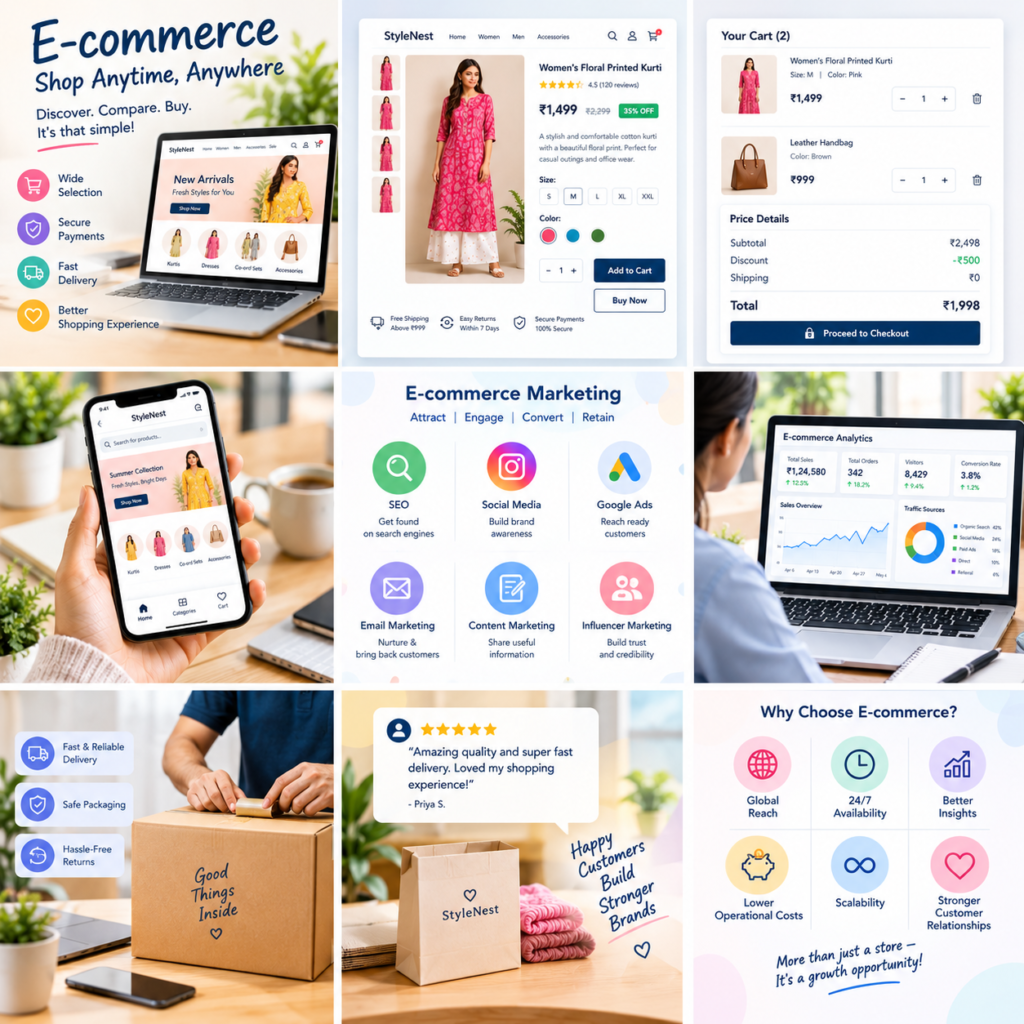
The boutique launches an online store selling:
- Kurtis
- Co-ord sets
- Anarkalis
- Accessories
The owner creates product pages with professional photographs, sizes, prices, descriptions and delivery information.
Then the digital marketing strategy could include:
SEO: Target searches related to women’s ethnic wear.
Instagram: Post styling videos and new arrivals.
Google Ads: Promote products to people actively searching for them.
Email marketing: Send new-collection announcements.
Retargeting: Re-engage visitors who viewed products but didn’t purchase.
Customer retention: Send personalized recommendations to previous customers.
This demonstrates how e-commerce and digital marketing work together.
The Future of E-commerce
E-commerce is becoming increasingly connected with social media, mobile experiences, artificial intelligence, personalization and multiple sales channels.
AI can help businesses analyze customer behavior, create marketing content, improve recommendations and automate certain customer-service tasks.
At the same time, businesses need to focus on the fundamentals: good products, trustworthy customer service, smooth checkout and reliable delivery.
Technology can attract customers, but customer experience is what helps turn a first purchase into a long-term relationship.
Conclusion
E-commerce has transformed traditional buying and selling by allowing businesses to reach customers through digital channels.
But building a successful e-commerce business is not simply about putting products on a website.
It requires a combination of:
Product + Website + Marketing + Technology + Customer Experience + Operations
For digital marketers, e-commerce provides an exciting area to develop skills in SEO, paid advertising, social media marketing, analytics, content creation, conversion optimization and customer retention.
Whether you are a large brand or a small business owner starting with a few products, the key is to understand your customer and create a buying experience that is simple, trustworthy and valuable.