Introduction
In today’s digital-first world, having an online presence is no longer optional—it’s essential. Whether you’re a small business owner, entrepreneur, freelancer, or marketer, digital marketing has become one of the most powerful ways to reach potential customers, build brand awareness, and drive business growth.
Unlike traditional marketing, digital marketing allows businesses to connect with their target audience through websites, search engines, social media platforms, email campaigns, and online advertising. It offers measurable results, better customer targeting, and cost-effective marketing solutions for businesses of all sizes.
In this guide, you’ll learn what digital marketing is, why it’s important, its major components, and how you can use it to grow your business successfully.
What is Digital Marketing?
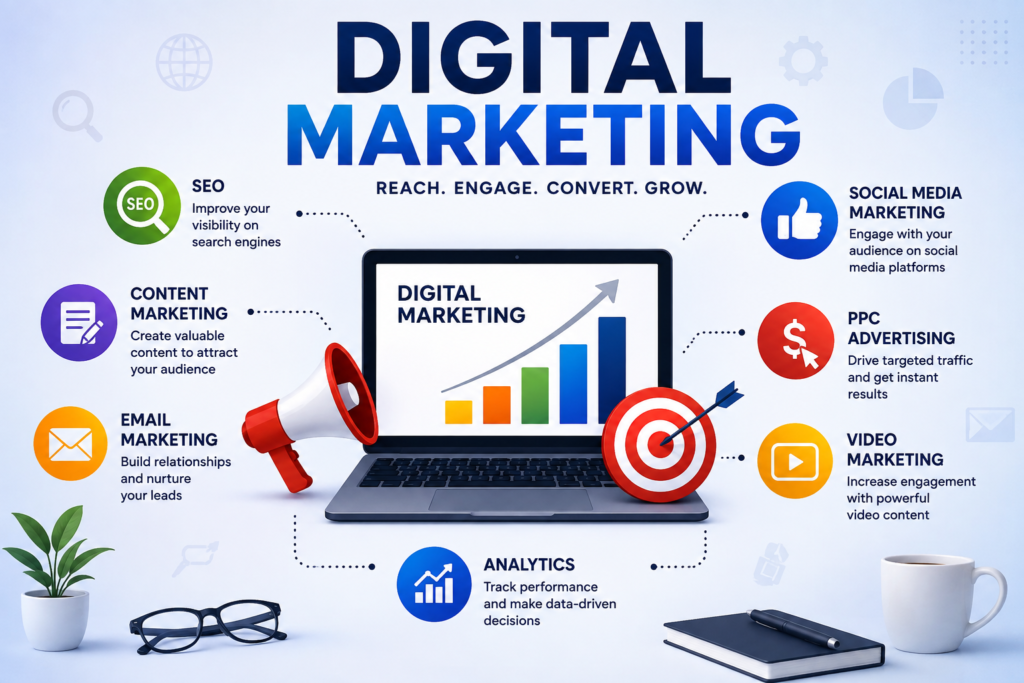
Digital marketing is the promotion of products or services using digital channels such as search engines, websites, social media platforms, email, mobile apps, and online advertisements.
The primary goal of digital marketing is to attract the right audience, engage them with valuable content, convert them into customers, and build long-term relationships.
From startups to multinational corporations, almost every successful business today uses digital marketing to increase visibility and generate revenue.
Why Digital Marketing Matters
Digital marketing has transformed the way businesses communicate with customers. Here are some reasons why it has become indispensable:
1. Reach a Global Audience
A business is no longer limited to its local area. With digital marketing, you can reach customers across cities, countries, or even the world.
2. Cost-Effective Marketing
Compared to television, newspapers, and billboards, digital marketing offers affordable advertising options with higher returns on investment (ROI).
3. Target the Right Customers
Digital platforms allow businesses to target audiences based on:
- Age
- Gender
- Interests
- Location
- Occupation
- Online behavior
This improves marketing efficiency and reduces wasted advertising spend.
4. Measure Performance
Unlike traditional marketing, every campaign can be tracked using analytics. Businesses can monitor website traffic, clicks, conversions, engagement, and sales in real time.
5. Build Long-Term Relationships
Through social media, newsletters, and personalized content, businesses can stay connected with customers and build trust over time.
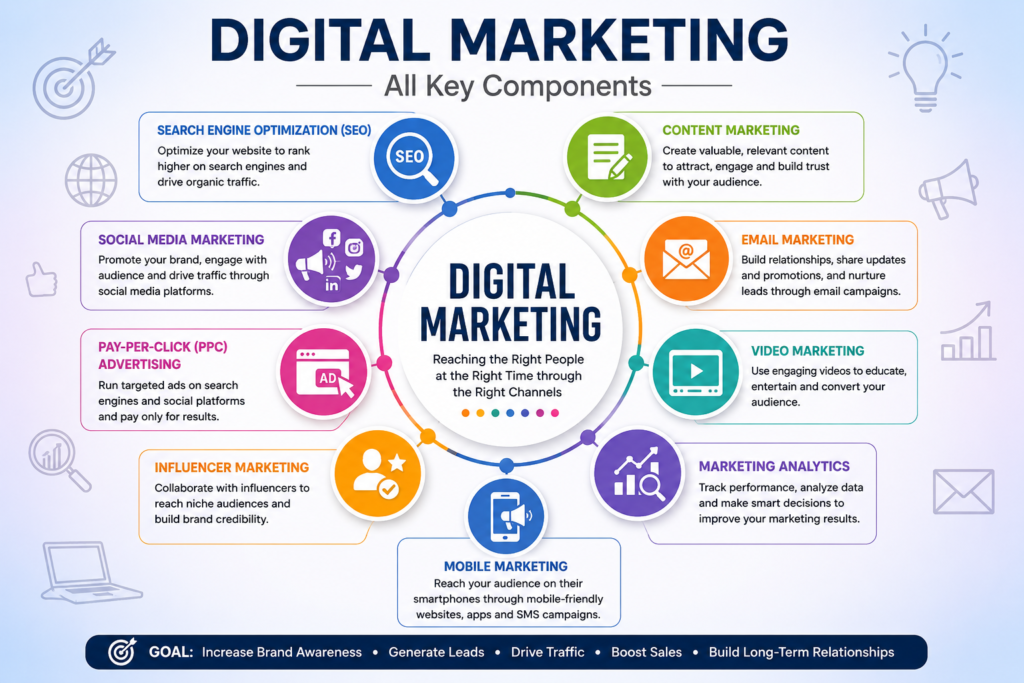
Key Components of Digital Marketing
1. Search Engine Optimization (SEO)
SEO is the process of improving your website so it ranks higher on search engines like Google.
Good SEO helps businesses:
- Increase organic traffic
- Improve website visibility
- Build credibility
- Generate consistent leads
SEO includes keyword research, content optimization, technical SEO, mobile responsiveness, and backlink building.
2. Content Marketing
Content is the foundation of digital marketing.
Businesses create valuable content such as:
- Blog posts
- Videos
- Infographics
- E-books
- Case studies
- Guides
- Podcasts
Quality content educates customers, answers their questions, and positions the business as an industry expert.
Remember:
Content informs, builds trust, and drives conversions.
3. Social Media Marketing
Billions of people use social media every day.
Platforms include:
- YouTube
- X (Twitter)
Businesses use social media to:
- Build brand awareness
- Engage with followers
- Showcase products
- Share customer stories
- Generate leads
- Drive website traffic
Consistent posting and audience engagement are key to success.
4. Email Marketing
Despite the rise of social media, email marketing remains one of the highest ROI marketing channels.
Businesses use email to:
- Welcome new customers
- Share promotions
- Send newsletters
- Launch products
- Recover abandoned carts
- Build customer loyalty
Personalized emails generally achieve better open and click-through rates than generic campaigns.
5. Pay-Per-Click (PPC) Advertising
PPC allows businesses to display paid advertisements on search engines and social media platforms.
Popular advertising platforms include:
- Google Ads
- Facebook Ads
- Instagram Ads
- LinkedIn Ads
Businesses only pay when someone clicks on their advertisement, making PPC highly measurable and scalable.
6. Influencer Marketing
Consumers trust recommendations from people they follow.
Brands collaborate with influencers to:
- Promote products
- Increase brand awareness
- Reach niche audiences
- Generate authentic content
Choosing influencers whose audience aligns with your target market is essential.
7. Video Marketing
Video has become one of the most engaging forms of digital content.
Popular formats include:
- Product demonstrations
- Tutorials
- Customer testimonials
- Short-form videos
- Live streams
- Educational content
Videos help explain complex topics while increasing audience engagement and retention.
Benefits of Digital Marketing
Digital marketing offers numerous advantages over traditional marketing.
Some major benefits include:
- Better customer targeting
- Higher return on investment
- Real-time analytics
- Increased website traffic
- Improved customer engagement
- Stronger brand recognition
- Faster lead generation
- Greater flexibility for campaign optimization
Businesses can start with a small budget and scale campaigns as they grow.
Common Digital Marketing Mistakes
Many businesses fail to achieve results because they make avoidable mistakes.
Some common mistakes include:
- Ignoring SEO
- Posting inconsistently on social media
- Not understanding the target audience
- Creating poor-quality content
- Focusing only on sales instead of providing value
- Neglecting mobile-friendly website design
- Failing to analyze campaign performance
Avoiding these mistakes can significantly improve marketing success.
Future Trends in Digital Marketing
Digital marketing continues to evolve with changing technology and consumer behavior.
Emerging trends include:
- Artificial Intelligence (AI) in marketing
- Voice search optimization
- Personalized customer experiences
- Marketing automation
- Short-form video content
- Conversational chatbots
- Data-driven decision-making
- Privacy-focused marketing strategies
Businesses that adapt to these trends will stay competitive in the digital landscape.
How to Get Started with Digital Marketing
If you’re new to digital marketing, follow these steps:
- Create a professional website.
- Understand your target audience.
- Optimize your website for search engines.
- Publish valuable content regularly.
- Build a presence on relevant social media platforms.
- Start an email list.
- Run targeted advertising campaigns when appropriate.
- Track performance using analytics tools.
- Continuously test and improve your strategies.
Consistency and patience are key to long-term success.
Conclusion
Digital marketing has revolutionized the way businesses connect with customers. It provides affordable, measurable, and highly targeted opportunities to grow online. Whether through SEO, content marketing, social media, email campaigns, or paid advertising, every strategy contributes to building a stronger digital presence.
Success in digital marketing doesn’t happen overnight. It requires a clear strategy, continuous learning, quality content, and regular performance analysis. Businesses that focus on providing value to their audience while adapting to changing trends will be better positioned for sustainable growth.
As more consumers rely on digital platforms to discover products and services, investing in digital marketing is no longer just an advantage—it’s a necessity. Start with the fundamentals, remain consistent, and keep refining your approach. Over time, digital marketing can become one of the most effective tools for expanding your reach, strengthening customer relationships, and achieving long-term business success.