The Future of Email Marketing
Technology continues to reshape digital marketing, and email marketing is no exception. Artificial intelligence, automation, and personalization are making campaigns smarter and more relevant than ever before.
Businesses can now send automated welcome emails, recommend products based on customer preferences, and schedule emails when subscribers are most likely to engage.
However, one thing remains unchanged: people value authentic communication. Technology can improve efficiency, but genuine, helpful, and relevant content is what builds lasting customer relationships.
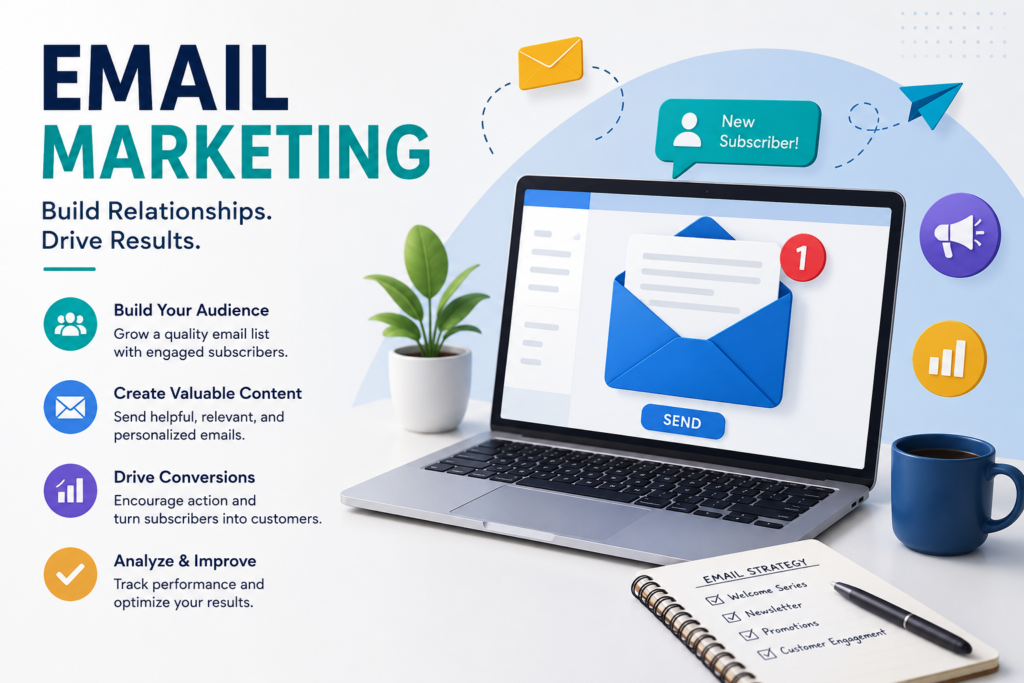
Why Is Email Marketing Important?
Email marketing remains valuable because it gives businesses a direct communication channel with their audience.
1. Direct Communication
An email reaches a person’s inbox rather than relying entirely on social media algorithms. This makes email particularly useful for maintaining an ongoing relationship with customers.
2. Lead Nurturing
Not every visitor is ready to purchase immediately. Email allows businesses to nurture potential customers by providing useful information over time.
For example:
Visitor → Email subscriber → Engaged lead → Customer → Repeat customer
This process can turn an initial interaction into a long-term relationship.
3. Personalization
Email campaigns can be personalized using information such as a subscriber’s name, interests, previous purchases, or interactions with your business.
Instead of sending exactly the same message to everyone, businesses can create more relevant communication for different audience segments.
4. Cost-Effective Marketing
Compared with many traditional advertising channels, email can be relatively inexpensive to operate, especially for small businesses. Automation also allows businesses to send certain messages without manually creating every campaign.
5. Measurable Results
One of the biggest advantages of digital marketing is the ability to measure performance. Email campaigns can be evaluated using metrics such as:
- Open rate
- Click-through rate
- Conversion rate
- Unsubscribe rate
- Bounce rate
- Revenue generated
These measurements help marketers understand what is working and what needs improvement.
Different Types of Email Marketing
Email marketing is not limited to promotional newsletters. Different emails serve different purposes.
Welcome Emails
A welcome email is sent after someone subscribes to your list. It is an opportunity to introduce your brand and explain what subscribers can expect.
Promotional Emails
These emails promote products, services, discounts, seasonal offers, or special events.
For example:
“New Collection Just Arrived – Explore Our Latest Styles.”
Newsletter Emails
Newsletters provide regular information, tips, educational content, company updates, or curated resources.
Abandoned Cart Emails
E-commerce businesses can remind customers about products they added to their shopping cart but did not purchase.
Product or Service Updates
Businesses can use email to announce new products, new services, features, events, or important updates.
Re-engagement Emails
If subscribers stop interacting with your emails, a re-engagement campaign can encourage them to return.
How to Build an Effective Email Marketing Strategy
Successful email marketing starts with a strategy rather than simply sending emails.
Step 1: Build a Quality Email List
Your email list is one of your most valuable marketing assets. Encourage people to subscribe through your website, landing pages, social media channels, events, or valuable resources.
Avoid purchasing random email lists. A smaller audience that genuinely wants to hear from you can be much more valuable than a large list of uninterested recipients.
Step 2: Segment Your Audience
Your subscribers are not all the same.
You could create segments based on:
- Location
- Interests
- Purchase history
- Engagement
- Customer status
- Products viewed
- Stage of the buying journey
Segmentation allows you to make your communication more relevant.
Step 3: Write Better Subject Lines
The subject line is one of the first things a subscriber sees.
Instead of:
“Our New Products”
try something more specific:
“5 New Styles You’ll Want to See This Week”
Your subject line should create curiosity while accurately representing the email’s content. Deceptive subject lines can damage trust and may also violate applicable commercial-email rules.
Step 4: Create Valuable Content
Every email should have a purpose.
Ask yourself:
“What will the reader gain from opening this email?”
Your content could educate, solve a problem, provide inspiration, announce something useful, or present a relevant offer.
The goal is to make subscribers look forward to receiving your emails.
Step 5: Add a Clear Call to Action
Every marketing email should guide the reader toward the next step.
Examples include:
- Shop Now
- Learn More
- Download the Guide
- Book a Consultation
- Explore the Collection
- Read the Full Article
Avoid overwhelming readers with too many competing actions.
Step 6: Test and Optimize
Email marketing improves through experimentation.
You can test different:
- Subject lines
- Headlines
- Images
- Offers
- Calls to action
- Email layouts
- Sending times
Over time, your campaign data can help you understand what resonates with your audience.
Important Email Marketing Metrics
Tracking performance is essential.
Open Rate: Shows the percentage of delivered emails that were opened. However, open-rate data can be affected by privacy features and should not be treated as a perfect measure of engagement.
Click-Through Rate (CTR): Measures how many recipients clicked links within the email.
Conversion Rate: Shows how many recipients completed the desired action, such as purchasing a product or submitting a form.
Unsubscribe Rate: Shows how many people opted out of your email list.
Bounce Rate: Indicates emails that could not be delivered.
Rather than focusing on one metric, marketers should evaluate several metrics together and connect them to business goals.
Common Email Marketing Mistakes
Many businesses make email marketing harder than it needs to be.
Common mistakes include:
- Sending emails too frequently
- Sending irrelevant content
- Using misleading subject lines
- Having unclear calls to action
- Ignoring mobile users
- Buying email lists
- Failing to clean inactive subscribers
- Sending overly promotional content
- Not testing campaigns
- Making unsubscribing difficult
The best email marketing strategies focus on relevance, value, consistency, and trust.
Email Marketing and Compliance
Businesses should understand the laws and regulations that apply to their audiences and locations.
For example, in the United States, the CAN-SPAM Act establishes requirements for commercial email, including truthful header information, non-deceptive subject lines, a clear opt-out mechanism, and prompt handling of unsubscribe requests. The Federal Trade Commission states that commercial senders must honor opt-out requests within 10 business days.
Businesses operating internationally may also need to consider other privacy and electronic-communications laws. Therefore, email marketing should be designed around both good marketing practices and applicable legal requirements.
The Future of Email Marketing
Email marketing is becoming increasingly sophisticated. Automation, audience segmentation, personalization, analytics, and artificial intelligence can help marketers create more relevant campaigns.
However, technology does not replace the fundamentals.
People still respond to emails that are useful, relevant, clear, and trustworthy.
The businesses that succeed will not necessarily be the ones sending the most emails. They will be the ones sending emails that their audiences actually want to receive.
Conclusion
Email marketing is much more than sending promotional messages to a list of subscribers. It is a powerful digital marketing strategy for building relationships, nurturing leads, increasing customer engagement, and supporting business growth.
A successful strategy starts with a quality email list, continues with relevant and valuable content, and improves through segmentation, testing, automation, and measurement.
If you are a beginner, start simple. Build your audience, understand what they need, send valuable content consistently, and measure the results.
The goal of email marketing is not simply to get an email opened. The real goal is to build enough trust that the subscriber wants to take the next step with your brand.