Introduction
When people need a product or service, one of the first places they often go is Google.
They might search for “best playschool near me,” “digital marketing agency in Bangalore,” “designer kurtis online,” or “best dentist near me.”
For businesses, this creates an important opportunity: How do you make your business visible when potential customers are searching?
Two of the most popular approaches are Search Engine Optimization (SEO) and Google Ads.
But which one should you choose?
The answer isn’t simply that SEO is better than Google Ads or vice versa. They solve different problems.
SEO is generally a long-term strategy for earning organic visibility, while Google Ads can provide paid visibility when you want to reach relevant searches and control your advertising campaign. Google itself describes SEO as improving a site’s presence in organic Search, while Google Ads allows businesses to bid for opportunities to show ads alongside relevant searches.
For many businesses, the smartest approach is actually SEO + Google Ads.
Let’s understand why.
What Is SEO?
SEO stands for Search Engine Optimization.
It involves improving your website and content so that search engines can better understand your pages and users can discover them through organic search results.
Google’s SEO guidance emphasizes helping search engines understand your content and helping users find your website through Search.
SEO can include:
- Keyword research
- Helpful website content
- On-page optimization
- Technical SEO
- Internal linking
- Local SEO
- Improving website experience
- Creating useful blog content
- Building relevant authority and links
For example, if you own a preschool in Bangalore, you might create a page targeting “playschool in Bangalore” and supporting content around topics parents actually search for.
If your page becomes visible in relevant organic results, people can discover your business without you paying Google for each organic click.
Google states that businesses do not pay to appear in organic search results.
What Is Google Ads?
Google Ads is a paid advertising platform that allows businesses to show advertisements to people searching for relevant products and services.
For example, if someone searches:
“best digital marketing course in Bangalore”
a business running a relevant Search campaign may be eligible to show an advertisement for that search.
Google Search Ads work through an auction system. Advertisers select relevant targeting and bids, while Google’s systems determine which eligible ads are shown.
With Google Ads, businesses can control factors such as:
- Advertising budget
- Keywords or targeting
- Location
- Ad messaging
- Landing pages
- Campaign objectives
Google Ads can therefore be useful when a business wants to generate visibility and traffic without waiting for organic rankings to develop.
SEO vs Google Ads: The Major Differences
| Factor | SEO | Google Ads |
|---|---|---|
| Type | Organic | Paid |
| Cost model | No payment to Google for organic clicks | Advertising spend |
| Speed | Usually takes time | Can generate visibility quickly |
| Long-term value | Strong potential | Depends on ongoing ad spend |
| Control | Less direct control over rankings | More control over campaign settings |
| Content requirement | Very important | Important for landing pages and ads |
| Best for | Long-term visibility | Immediate/short-term campaigns |
| Suitable for | Sustainable organic growth | Leads, sales and promotions |
The biggest difference is simple:
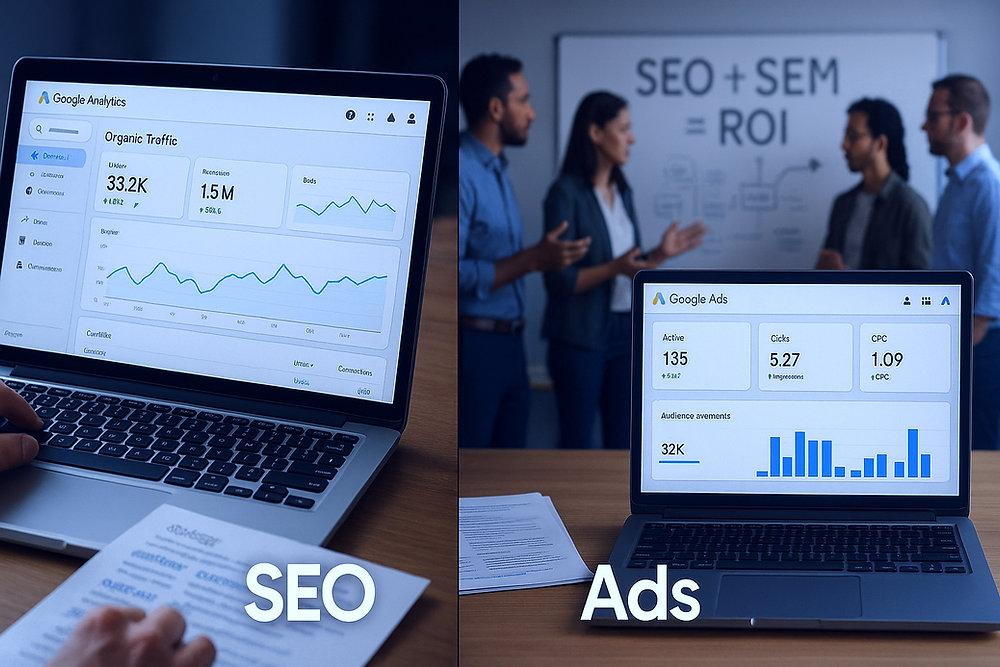
SEO aims to earn visibility. Google Ads pays for advertising opportunities.
Which Is Better for a New Business?
Imagine you have just launched a new business website.
You have almost no organic search visibility yet, but you need customers.
This is where Google Ads can be useful.
You can create a campaign targeting relevant searches and send potential customers to a landing page.
At the same time, you can start building SEO.
This creates a useful two-part strategy:
Google Ads → Immediate visibility
SEO → Long-term organic visibility
Instead of waiting months for SEO before starting marketing, a business can use paid search while its organic presence develops.
When Should You Choose SEO?
SEO may be a better priority when:
1. You Want Long-Term Traffic
If you want your website to attract relevant organic visitors over time, SEO should be part of your strategy.
2. You Have Useful Content to Share
Businesses that can consistently create helpful articles, guides, service pages and resources can build an organic search presence.
3. Your Customers Search Before Buying
SEO can be particularly valuable when potential customers actively search for information related to your products or services.
4. You Want to Build an Online Asset
Unlike an advertising campaign that stops delivering when you stop spending, successful SEO work can continue attracting organic visibility after the initial work is completed.
However, this does not mean SEO is free or guaranteed. Businesses still need to invest time, expertise, content and website improvements, and Google does not guarantee first-page rankings.
When Should You Choose Google Ads?
Google Ads may be a better priority when:
1. You Need Leads Quickly
If your business has an immediate sales target, paid search can help you reach people actively searching for relevant offerings.
2. You Have a Time-Sensitive Offer
Suppose you’re running a limited-time sale, admission campaign or seasonal promotion.
Google Ads can help you promote that offer while it is relevant.
3. You’re Launching a New Product
A new product may not have strong organic rankings yet. Paid search can provide another route to visibility.
4. You Want More Campaign Control
Google Ads allows you to set budgets, targeting and campaign parameters, giving you more direct control over the advertising activity.
What About Cost?
This is where many business owners misunderstand SEO and Google Ads.
They may think:
“SEO is free, and Google Ads is expensive.”
That’s not quite accurate.
With SEO, you may not pay Google for organic clicks, but you still have costs such as:
- SEO tools
- Content creation
- Website development
- Technical improvements
- SEO professionals or agencies
- Time spent researching and optimizing
With Google Ads, you directly allocate an advertising budget and pay according to the campaign’s charging model.
Therefore, the real question isn’t simply:
“Which one is cheaper?”
It is:
“Which channel produces the best business results for my budget and goals?”
Can SEO and Google Ads Work Together?
Absolutely—and this is often the most practical approach.
SEO and Google Ads can support each other.
Suppose you sell online courses.
You could use Google Ads to target high-intent searches such as:
“digital marketing course online”
At the same time, your SEO strategy could target informational searches such as:
- What is digital marketing?
- How to learn digital marketing?
- SEO vs SEM
- Digital marketing career options
The paid campaign can focus on immediate opportunities, while SEO builds organic visibility around relevant topics.
Google also notes that thinking about SEO and PPC together can create a more comprehensive search marketing strategy.
A Practical Example
Imagine a small boutique in Bangalore.
The owner wants more customers.
Option 1: Only SEO
The boutique creates:
- Product pages
- Fashion blogs
- Local SEO content
- Styling guides
- Optimized category pages
Over time, these may help the website become more visible in relevant searches.
Option 2: Only Google Ads
The boutique runs Search Ads for relevant commercial searches and sends visitors to product or landing pages.
This can provide immediate advertising visibility, but the business needs ongoing advertising spend.
Option 3: SEO + Google Ads
The boutique runs targeted Google Ads while simultaneously building organic visibility.
This provides a more balanced approach:
Short term → Google Ads
Long term → SEO
Overall strategy → Both
How to Decide: SEO or Google Ads?
Ask yourself these five questions:
Question 1: Do I need customers immediately?
Yes → Consider Google Ads.
Question 2: Am I building a long-term online presence?
Yes → Invest in SEO.
Question 3: Do people actively search for my product or service?
Yes → Both SEO and Google Ads may be valuable.
Question 4: Do I have a limited advertising budget?
Yes → Test carefully, track conversions and consider building SEO alongside paid campaigns.
Question 5: Do I have time to create useful website content?
Yes → SEO can become an important long-term channel.
The Best Strategy for Most Businesses
Instead of asking:
“SEO or Google Ads?”
ask:
“How can SEO and Google Ads work together?”
Use Google Ads when you need targeted paid visibility, especially for high-intent searches, new offers or campaigns where speed matters.
Use SEO to build your website’s organic presence, useful content and long-term discoverability.
Then measure both channels based on business outcomes, not just clicks.
Track metrics such as:
- Leads
- Sales
- Cost per lead
- Conversion rate
- Revenue
- Return on ad spend
- Organic traffic
- Organic conversions
A high number of visitors means little if those visitors never become customer
Conclusion
SEO and Google Ads are not competitors. They are two different tools within a broader digital marketing strategy.
SEO is a long-term investment in organic visibility.
Google Ads is a paid channel designed to provide targeted visibility and campaign control.
If you need immediate visibility, Google Ads may be the better starting point.
If you want to build sustainable organic visibility, SEO should be a priority.
And if your budget and resources allow it, combining both can give your business a stronger search presence.
The most important thing is not choosing the trendiest marketing channel. It is choosing the channel that matches your business goals, customer behaviour, budget and timeline.